When I woke I was so weak, I had no idea how much time had passed. I was in a basic room where there was a line of beds. My body felt empty, probably because it was, but I did not feel hungry.
Moving took all my effort, but there was bright sunlight outside and the air was warmer, clearer than Delhi. To be honest the next few hours are difficult to recall.
I never did find out how much I slept or what the doctor had injected me with. I could not even tell you what time I got off the train and how long I had been asleep. Piecing together what the others in the group told me they went to the Ashram and had an evening out meeting the team from Women in Need.
They had met Mrs Chouglay, our contact, and Dr Sharma. To me he sounded like an almost mythical figure. An aged man who had met Gandhi and then worked alongside one of Gandhi’s main ‘disciples’ to establish the Ashram. The history here is a bit hazy – he was certainly a man who had experienced those great modern moments in the history of this country.
What I thought was an individual hut turned out to be a dormitory, one of four, that had a central area in the middle. Outside it was hot, the blue sky and lack of pollution creating a different environment.
There’s a sense of excitement arriving somewhere and having no recollection of how you got there. Falling asleep on a long journey adds to the wonder of a trip. It happened to me as a fifteen year old when we were taken on a school trip to the Isle of Iona, off the west coast of Scotland, by our R.E, teacher. Having stayed awake for the whole train journey and transfer to a ferry at Oban – it was on the bus trip across Mull that I eventually gave in to fatigue. I slept for an hour and woke as we were boarding the small passenger ferry to the island. Looking back I could see the highest mountains I had ever encountered, there was snow on the peaks. The warm wind blew in from the sea and the golden white beaches merged from the luscious green dunes.
That sense of mystery looking to the mountains stayed with me the whole week and made the trip more magical. Here I was on another school trip thirty years later. A long way from a small Scottish island.
We were staying in Dattapur at the Centre for Scientific Villages. A quick bit of history here (as I understand it, apologies to anyone if it’s not strictly correct).
Gandhi’s Ashram was nearby at Wardha (more of that later). He spent seventeen years here and one of the things he wanted to promote was that people should learn to live with nature. Not to exploit it but take what they needed while ensuring it was self-sustaining. From this they set up a centre to study how best to work with the land and then educate villagers as to how to achieve this. From irrigation to recycling this was a project ahead of its time.
One small example: they used to destroy bee hives to get the honey. Here they examined the problem and worked out how to harvest the honey and not destroy the wild hives so that there would be an ongoing supply, plus the bees were not destroyed. Banana leaves were thrown away, here they learnt how to use them to make paper… and so on.
The group had had a good night out and were acclimatising to this new environment. I think I met the doctor again and was given the all clear. I was now on alert about food and although my stomach was totally empty I had no desire to eat.
Meals were taken in a small hut at the back end of the grounds. It was a basic rectangular building, with a large rectangular table in the middle of the room. There was a counter at one end where food was placed in large metallic bowls and we went up, collected smaller metal bowls, and took what we wanted. Behind the counter sat two or three locals. They watched us with stern faces, not knowing what we were saying. The food was always basic, no meat, but they did attempt to vary what was served even though potatoes, cauliflower, ochre and dal seemed to be the staple ingredients.
Three times a day we were summoned in, and as we worked harder the meals became more important.
When you have a stomach that had rejected all food it was very difficult. The staff must have thought me greedy or strange. They gave us these small cups to drink the sweet chai from. All my body seemed to want was fluid, so I went in with my green metal mug (with Corporal Jones from Dad’s Army on it emblazoned with ‘Don’t Panic’) and filled it and drank, and filled it again and drank. It was life-giving. I tentatively tried a small portion of rice and that was my meal. I was weak, struggling still, but this was the start of the comeback. The air was hot, I was drinking and the longest sleep in my life had reset my body.
I don’t think I ever really explained how bad it was for me to Gilly. She was the group leader and I was meant to be helping her. Delhi had knocked me back, the train had knocked me out. I needed to recuperate which was difficult with us always moving or working. Being mentally and physically low I found that the company of the students allowed me to relax more, we could sit and laugh and they would raise my spirits and I would join in.
Gilly was a bit more tense, it was her trip and she had to get us through safely. She took her responsibilities very seriously, as you would expect, we were now aware of the issues of how food could really take us out. She had got us on the train when the tickets had been an issue, she had got those of us who were ill to the Centre and the pressure must have been intense upon her. Unfortunately I couldn’t help her, I couldn’t take that pressure from her, I was so far from my comfort zone.
I was struggling and needed to be part of the group, not a leader. I grew closer to some of the students, we joked and took things less seriously, not what a leader should do. Gilly got us through that trip single-handedly, I would have my moments and my role developed, but for now she was leading on her own.
The Women in Need charity is an extraordinary charity. It is run by a westerner, Leah, a former nurse from the north-east of England and Usher a local woman. Later I asked Leah if it was a Christian act that she gave up everything to stop here and help some many of the destitute and outcast. She replied that she came here while traveling, put her rucksack down and realised that this was where she should be and what she should do.
We were to work with former leprosy patients who had been outcast by their females. They were mainly fragile old women who would have otherwise been totally rejected by society. Leah arrived here and set about cleaning the place up, applying proper hygiene. Through her bravery and dedication the women lived in some dignity now, you felt a sense of community.
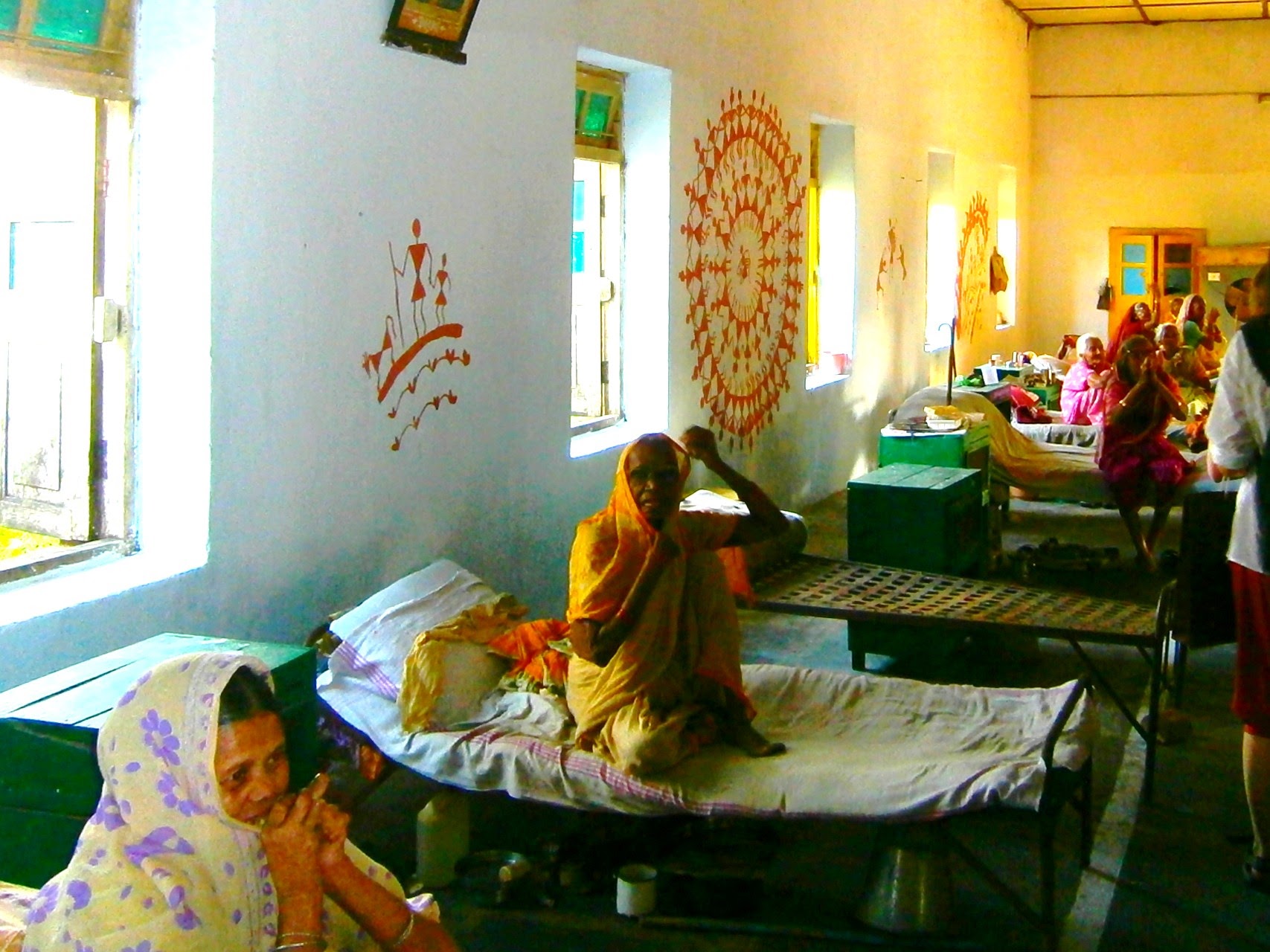
Set up as an ashram, there were long concrete buildings lined on either side by beds, on which the old ladies sat. It is an incredible feeling to come so close to something like this. As with the orphans in Delhi we were looking at people whose whole live was in a few drawers by their bed side.
We walked down the aisle, some of the ladies smiled and waved while others quickly hid their faces. There were some with twisted feet and fingers but I felt no disgust or horror, what would be the point of that? Our job here was to work to make the centre brighter and even more habitable.
The temperature was hot and it took some time to process. Sitting in that hot sun we looked over the ramshackle buildings. This might have been a thriving community and one point but now it seemed only a handful of buildings were being used.
We were to divide into two groups, those who were creative were going to work inside the dormitories painting designs on the walls – the rest of us outside painting the exterior of some buildings. It was an easy choice for me being unable to do anything ‘arty’, I would be in charge of the painting team responsible for ‘sprucing up’ an old post office building.
Health and safety does not exist in India. You do a job and hopefully you get away with it without injury. Trying to paint the complete front of a two storey building was going to pose some problems, but he had to work out a solution.
On the site somewhere the most rickety home-made step ladder ever constructed was found. It was about eight feet tall and had the narrowest metal that you would ever have seen. It did not look as though it could take a person’s weight, but it was all we had so I had to send one of the students up it to paint the higher parts of the wall. I have a picture of Jack on top of it leaning against the wall while David was painting and holding the step ladder together underneath him.
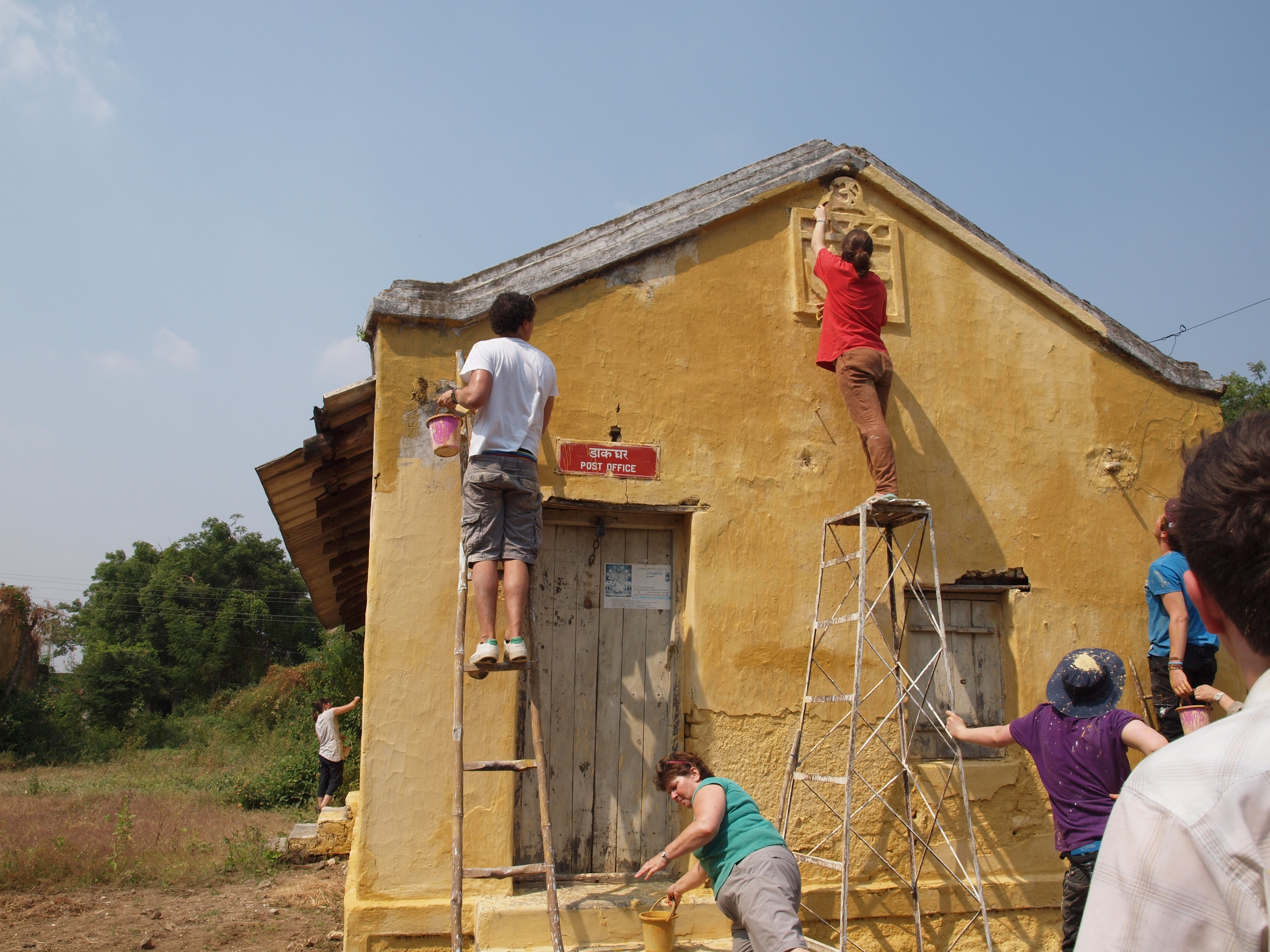
We set about our work repairing the monsoon damage and turning a dirty cream exterior into a bright yellow with red trimmings. No complaints about the heat, no complaints about the work and no complaints about hanging off the weakest step ladder ever created. Magnificent young people!
I was happy again. The warm sun and a sense of purpose. Working with the students, realising that I should be the foreman and not doing any painting myself!
And then called back for lunch in the hut at our site, before returning to finish.
My mind was unscrambling, the evening meal was a more upbeat time with memories of the day fresh. No major incidents and a sense of achievement all round. Sleeping under the mosquito net was easy as I was tired from the heat and work and my body was still weak. Anyway, who’d want to stay up, there might be a tiger out there…
We had been told that the national parks and nature reserves were closed so we did not even think to investigate whether we could visit one. On this evening my sense of humour had recovered enough to start preying on the nerves of a couple of the girls. The locals who worked on the site became very excitable for some reason and in the darkness they started running around, shouting and getting in and out of cars. We had no idea what was going on… until one of the girls asked me if I knew:
“They think they saw a tiger,” I said in the most matter of fact voice I could.
We were standing on the edge of the dining hut, the night was dark was lusciously warm. The girl disappeared into the hut to quickly spread the news. I did not realise that there really was some anxiety about meeting one of our striped friends. There definitely was something going on and it was almost perfect that the group could see the excitement of the men.
It was time to play on this. Strict instructions were given that nobody was allowed to be on their own and walking between the dining hut and the dormitory hut should only be done at a slow pace and silently. It wound the group up like a spring. For the next half an hour we listened out into the night as the silence was broken by the odd shout or an engine starting and stopping.
As far as I knew there was only the crickets out there. There were monkeys in the trees, and they were not friendly ones either, but I suppose there could have been snakes or other such animals on the prowl.
I can’t correctly recall whether we told everyone the truth that night or not. When we had our last night debrief in Delhi before flying home I do remember telling the tiger story and Billie, one of the girls, being shocked that I had made it up. I wonder how many emails or texts were sent home stating that here had been a tiger on the prowl in our grounds…
 Reluctant travels in India
Leave a comment